Before the Minutes: Why Groups Kept Written Records
Why groups kept written records: learn how dated notes preserve local decisions, explain changing traditions, and help new members understand a group’s history.
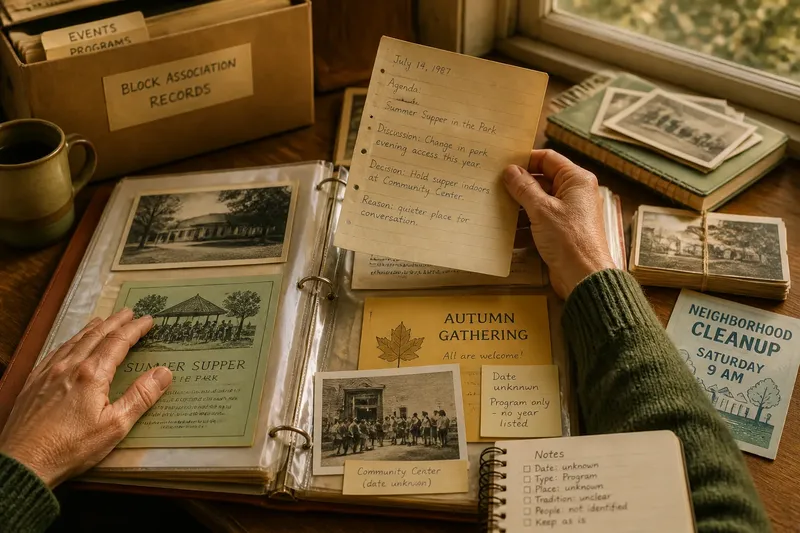
A neighbor opens a worn binder to check why the block association stopped holding its summer supper in the park. The old notes mention a change in the park’s evening access, a detail that helps the current group understand its own history. Why groups kept written records is not only a question about meeting efficiency; records also explain how local customs took shape.
Written records preserve more than decisions
Minutes are a concise account of a meeting, but a group’s records can include more: flyers, event programs, letters, photographs, and notes about recurring traditions. Together, these materials show what people did and the circumstances that shaped their choices.
A decision to move a gathering indoors, for example, may seem arbitrary years later. A dated note that says the group wanted a quieter place for conversation gives the choice context without turning it into a permanent rule.
Records also show how a group changes. An early program might list a single annual picnic, while later programs show that neighbors added a cleanup or invited nearby groups. The sequence matters: it lets future members see a tradition as something people adapted, not simply inherited.
Local records connect choices to their time and place
Names of streets, buildings, organizers, and local partners can make an old record understandable. If a group writes only “the usual room,” someone reading the notes later may not know which room that meant. Naming the community center or library branch preserves a useful reference, even after the group changes meeting places.
Brief context can distinguish a trial from a lasting arrangement. “Use the library meeting room for this gathering while the community center is unavailable” records a temporary reason; “the group chose the library as its regular meeting place” records a continuing decision.
Photos and programs can fill in details that minutes do not capture, such as a hand-painted sign or the names of partner organizations. Add a date and a short description when possible, so an image does not become an unidentified file detached from the event it shows.
A small archive can make local memory usable
A group does not need a formal archive to preserve its history. It can choose a few consistent practices that make materials easier to understand and locate:
- Check the date: If a note or flyer has a clear meeting or event date, keep that date in its file name; if the date is uncertain, mark it as uncertain rather than guessing.
- Check what the item records: If a document shows a decision, label it as minutes or a decision note; if it is an invitation or draft, label it accordingly so readers do not mistake it for an official record.
- Check the place name: If the venue is identifiable, include its name in the description; if not, record “venue unclear” and avoid assigning a location from memory alone.
- Check whether a tradition was temporary: If the record calls an event a trial or one-time arrangement, preserve that wording; if its status is unknown, describe what happened without presenting it as a permanent custom.
- Check for personal details: If a record includes private information that is not needed to explain the group’s work, restrict access or make a privacy-conscious copy; if the information is essential, follow the group’s sharing rules before circulating it.
- Check for duplicate or incomplete files: If two copies differ, keep both until the group can identify which is final; if a scan is unreadable, retain the original and make a clearer copy when practical.
- Check how a new member would search: If a title names the event, place, or subject, keep it; if it says only “notes,” rename the file with details that are clear and supported by the record.
Imagine a fictional neighborhood group finds a program marked “Autumn gathering” with no year, a photograph showing the community center, and minutes from a later meeting. First, its members record that the program’s date is unknown rather than infer a year. Next, they describe the photograph as showing the center without claiming it proves the program took place there. Then they compare the later minutes for a clear reference to the gathering; if the minutes identify a year and venue, they can add that supported context, while leaving any unanswered detail marked unknown. The result is a useful record that separates evidence from guesswork.
Preserving local records does not require preserving everything
A record should help someone understand the group’s work, not reproduce every conversation or collect personal details without a purpose. Keep the decision, the relevant context, and any follow-up that explains what happened next. Leave out side conversations that do not illuminate the group’s history.
It is not worth the effort to create elaborate labels for every scrap of paper or to reconstruct details no one can verify. A clear date, a plain description, and an honest note about uncertainty usually serve future readers better than a polished but speculative story.
When a record contains sensitive information, consider who needs access and whether a less detailed copy can serve the historical purpose. Groups with formal retention or privacy obligations should consult an appropriate qualified professional about those requirements.
How can a group make old records easier to understand?
What should a group write on an undated photograph?
Describe what is visible, such as a banner, building, or event activity, and mark the date as unknown if it cannot be established. Add a date or event name only when another reliable record supports it.
Should old drafts be kept with approved minutes?
Keep drafts separate from confirmed minutes and label their status clearly. If a draft contains a detail missing from the approved record, do not treat it as settled history without checking the group’s practice or other supporting material.
How should a group record a tradition that changed?
Describe the sequence in dated entries, noting what changed and any reason recorded at the time. If the reason is not documented, state that the record does not explain it rather than supplying a later guess.
What if the group cannot identify a person or place?
Use a neutral description such as “organizer not identified” or “venue unclear.” That wording preserves what the record can establish and makes the gap visible to future readers.
Why groups kept written records becomes clearer over time
As years pass, a collection of dated notes and event materials can show how people responded to changing places, needs, and relationships. A new volunteer may learn why a gathering moved, which partners helped shape it, or when a familiar custom first appeared in the surviving record.
Why groups kept written records becomes clearer when those records distinguish what is known from what remains uncertain. Use straightforward file names, keep confirmed material separate from drafts, and explain where the group stores its records to people who join later. That small care lets local memory remain useful without pretending the archive can answer every question.